Research & Citations
All citations and abstracts for JointsReport.com now live on this page (moved off the long article so the article can stay readable). The long page on this site is blunt on purpose. This page is the paper trail - the 'receipts' - as it were. Claims about form, absorption, and “it failed the big trial” belong next to the actual papers — not next to a celebrity bottle.
Educational video: The Science of Human Joints (MD’s Choice / Joint Science).
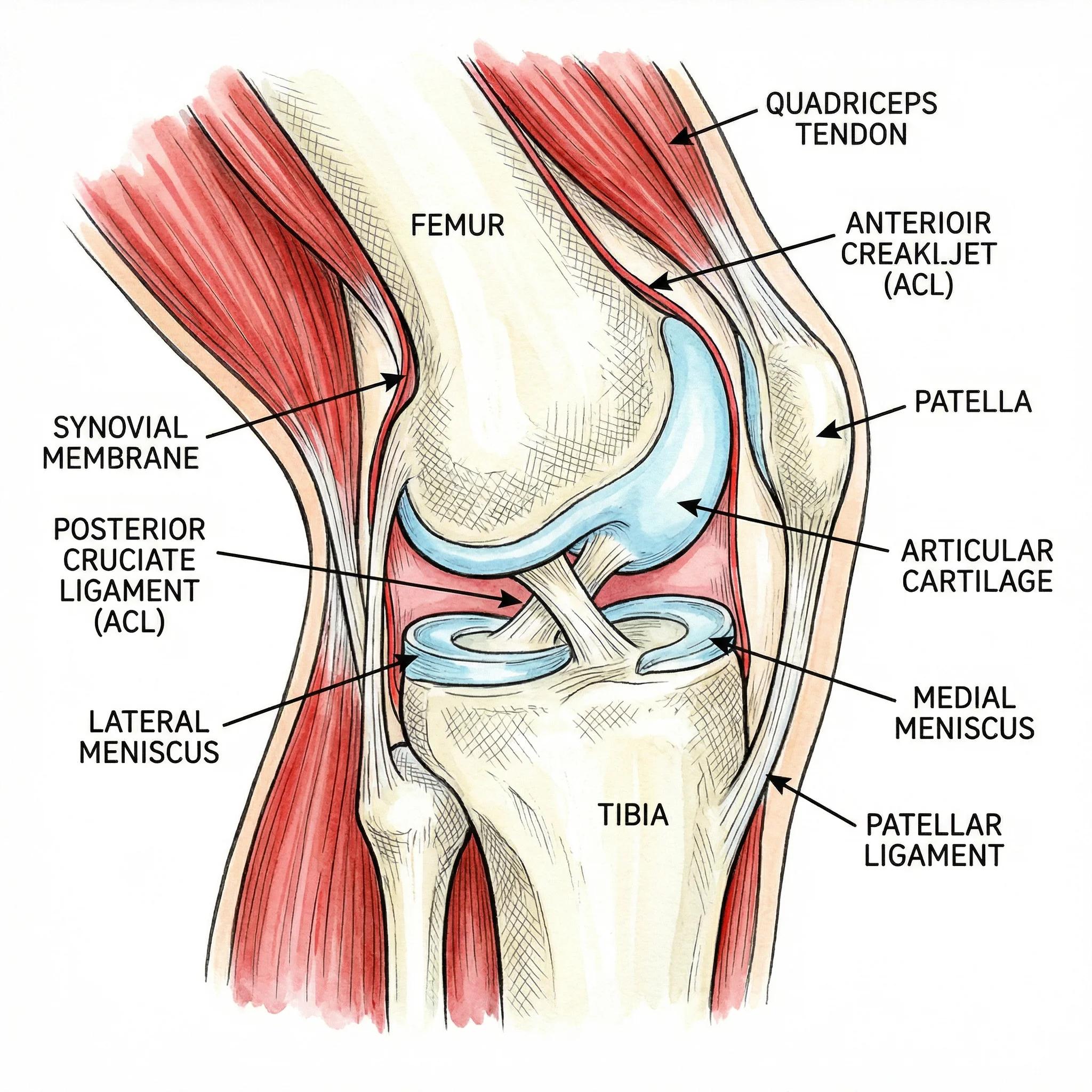
Knee joint anatomy — frequent subject of the trials cited below.
1. The trial that joint-aisle marketing still tries to outrun
Clegg DO, et al. Glucosamine, chondroitin sulfate, and the two in combination for painful knee osteoarthritis. N Engl J Med. 2006;354:795–808.
Finding: 1,583 adults. Glucosamine HCl 1500 mg, chondroitin sulfate 1200 mg, both, celecoxib, or placebo for 24 weeks. In the overall group, glucosamine and chondroitin — alone or together — did not reduce pain effectively versus placebo. Celecoxib did. An exploratory subgroup with moderate-to-severe pain looked better on the combination; that was not the primary result.
On-site line: GAIT used glucosamine hydrochloride (HCl), not glucosamine sulfate 2KCl. That is why this site will not let a label that says only “glucosamine” slide.
Sawitzke AD, et al. The effect of glucosamine and/or chondroitin sulfate on the progression of knee osteoarthritis: a report from the glucosamine/chondroitin arthritis intervention trial. Arthritis Rheum. 2008;58:3183–3191.
Finding: Two-year GAIT ancillary study on joint-space width. No statistically significant structural win for glucosamine hcl, chondroitin, or the combination versus placebo in the overall analysis.
2. Form is not a marketing adjective
Setnikar I, Rovati LC. Absorption, distribution, metabolism and excretion of glucosamine sulfate. A review. Arzneimittelforschung. 2001;51:699–725.
Finding: After oral crystalline glucosamine sulfate traced with 14C, fecal excretion over 120 h was 11.3% of the dose — at least 88.7% left the gut. Absolute oral bioavailability on globulin-incorporated radioactivity was about 44% after first-pass. Free glucosamine in plasma was often below older assay limits.
On-site line: The “close to 90% absorbed” figure on this site is the gastrointestinal-disappearance number from this line of work
Setnikar I, Palumbo R, Canali S, Zanolo G. Pharmacokinetics of glucosamine in man. Arzneimittelforschung. 1993;43:1109–1113.
Finding: Oral 14C-glucosamine sulfate: a proportion close to 90% absorbed; free glucosamine not detectable in plasma with that method; radioactivity later in plasma proteins; oral AUC about 26% of IV (first pass).
Chomchareon T, et al. Bioequivalence study of 500 mg glucosamine sulfate in Thai healthy volunteers. J Med Assoc Thai. 2009;92:1040–1047.
Finding: Glucosamine sulfate KCl vs NaCl, 500 mg, 24 healthy adults. Cmax and AUC ratios inside 80–125%. 2KCl and NaCl salts were bioequivalent for rate and extent of absorption.
On-site line: The site’s preference for the potassium salt is a formulation / sodium-load choice, not a claim that NaCl “does not work.” Both sulfate salts get in. HCl is the form GAIT actually tested by NIH, and multiple universities, proven NOT TO WORK better than the placebo.
Tungtongjit T, et al. Comparable clinical outcomes between glucosamine sulfate-potassium chloride and glucosamine sulfate sodium chloride in mild and moderate knee osteoarthritis. J Med Assoc Thai. 2010.
Finding: Short-term RCT: GS-K 1500 mg vs GS-Na 1500 mg — similar WOMAC/SF-36 change; potassium rose more in the KCl arm but stayed in range.
3. Chondroitin is a different-sized object
Jackson CG, et al. The human pharmacokinetics of oral ingestion of glucosamine and chondroitin sulfate taken separately or in combination. Osteoarthritis Cartilage. 2010;18:297–302.
Finding: No evidence that ingested chondroitin sulfate appeared in the circulation under the regimens tested. Combining CS with glucosamine reduced glucosamine Cmax and AUC versus glucosamine alone.
On-site line: A large GAG in the capsule is not automatically a GAG in the joint space. Pain stories after CS, if real, may not be “the molecule parked itself in cartilage.”
4. Oral hyaluronic acid is not an injection in a capsule
Šimek M, et al. Molecular weight and gut microbiota determine the bioavailability of orally administered hyaluronic acid. Carbohydr Polym. 2023.
Finding: 13C-HA in mice. Gut microbes (Bacteroides) chop HA to small oligosaccharides; some absorb; the rest become short-chain fatty acids. Oral bioavailability about 0.2%. Authors say distal effects (skin, joint) are unlikely to be intact HA arriving at the site.
On-site line: “Most of the oral HA never shows up as HA in the joint” is the conservative reading. The site’s “over 90% in the poop in 24 hours” is stronger than this paper; this paper says most of the carbon is metabolized, not delivered as polymer to cartilage. Do not over-claim fecal recovery unless you have that assay.
Kimura M, et al. Absorption of orally administered hyaluronan. J Med Food. 2016;19:1172–1179.
Finding: Oral HA degraded by cecal content, not by gastric/intestinal juice alone; oligosaccharides can cross large-intestine sacs; labeled pieces later found in rat skin. Mechanism is breakdown-then-absorb, not intact polymer transit.
5. Herbs in a daily joint bottle are still drugs
Devil’s claw, yucca, boswellia, and “herbal flex” blends belong on HerbsAreDrugs and in LiverTox / interaction lists — not in a product you take every morning for years because a label said “joint support.”
The site’s older line that daily yucca makes joints “age much quicker” is a strong claim. A 2023 feedlot paper on Yucca schidigera extract in cattle is about rumen fermentation.
HerbsAreDrugs research file · LiverTox · Ang-Lee JAMA 2001 perioperative herbs PMID:11448272
Navarro VJ, et al. Liver injury from herbals and dietary supplements in the U.S. Drug-Induced Liver Injury Network. Hepatology. 2014.
Finding: Herbals and dietary supplements accounted for a rising share of drug-induced liver injury cases in the DILIN registry — not a theoretical risk list.
Geller AI, et al. Emergency department visits for adverse events related to dietary supplements. N Engl J Med. 2015;373:1531–1540.
Finding: An estimated 23,000 ED visits per year in the U.S. were attributed to herbal dietary supplements with plant derived drug activity. “Natural” is not the same as “harmless in a daily bottle.”
Asher GN, Corbett AH, Hawke RL. Common herbal dietary supplement–drug interactions. Am Fam Physician. 2017;96:101–107.
Finding: Clinical review of herb–drug interactions that matter in primary care. Daily “joint herb” blends are still pharmacology.
6. Sulfate-form structure trials (not GAIT’s HCl)
Reginster JY, et al. Long-term effects of glucosamine sulphate on osteoarthritis progression: a randomised, placebo-controlled clinical trial. Lancet. 2001;357:251–256.
Finding: 212 people with knee OA, 3 years, 1,500 mg glucosamine sulphate vs placebo. Mean joint-space loss was smaller on sulphate (−0.06 mm) than placebo (−0.31 mm). WOMAC improved on sulphate.
Pavelka K, et al. Glucosamine sulfate use and delay of progression of knee osteoarthritis. Arch Intern Med. 2002;162:2113–2123.
Finding: 202 people, 3 years, crystalline glucosamine sulphate. Less severe joint-space narrowing than placebo.
Herrero-Beaumont G, et al. Glucosamine sulfate in the treatment of knee osteoarthritis symptoms: a randomized, double-blind, placebo-controlled study using acetaminophen as a side comparator (GUIDE). Arthritis Rheum. 2007;56:555–567.
Finding: Crystalline glucosamine sulphate 1,500 mg once daily beat placebo on Lequesne index; acetaminophen as side comparator did not.
Meulyzer M, et al. Comparison of pharmacokinetics of glucosamine and synovial fluid levels following administration of glucosamine sulphate or glucosamine hydrochloride. Osteoarthritis Cartilage. 2008;16:973–979.
Finding: Horses, equivalent doses. Crystalline sulphate had higher median oral bioavailability than HCl (9.4% vs 6.1%) and delivered more glucosamine into synovial fluid.
On-site line: Form is not a slogan. Same sugar, different salt, different amount that shows up in the joint fluid in this veterinary PK work.
Bruyere O, et al. Total joint replacement after glucosamine sulphate treatment in knee osteoarthritis: hints of a therapeutic delay. Osteoarthritis Cartilage. 2008;16:254–260.
Finding: Follow-up after long-term crystalline glucosamine sulphate use: fewer total knee replacements over ~5 years versus the original placebo arm. Observational after the RCTs — not a GAIT-HCl result.
Phitak T, et al. Effects of glucosamine-derivatives and uronic acids on glycosaminoglycan metabolism. BMC Musculoskelet Disord. 2010;11:162. (related chondroprotection line)
Finding: In cartilage-explant work, glucosamine sulfate showed stronger protection against induced matrix degradation than glucosamine HCl. Form again, not the word “glucosamine.”
Noack W, et al. Glucosamine sulfate in osteoarthritis of the knee. Osteoarthritis Cartilage. 1994;2:51–59.
Finding: Early multicenter RCT: glucosamine sulfate as a symptomatic slow-acting drug for knee OA versus placebo.
Pujalte JM, Llavore EP, Ylescupidez FR. Double-blind clinical evaluation of oral glucosamine sulphate in the basic treatment of osteoarthrosis. Curr Med Res Opin. 1980;7:110–114.
Finding: Early oral glucosamine sulfate vs placebo in osteoarthrosis; symptom lessening reported. Historic sulfate-form data — decades before GAIT tested HCl.
7. MSM is sulfur, not a painkiller herb
Kim LS, et al. Efficacy of methylsulfonylmethane (MSM) in osteoarthritis pain of the knee: a pilot clinical trial. Osteoarthritis Cartilage. 2006;14:286–294.
Finding: MSM 3 g/day, 12 weeks, modest pain/function change vs placebo in a small trial.
Debbi EM, et al. Efficacy of methylsulfonylmethane supplementation on osteoarthritis of the knee: a randomized controlled study. BMC Complement Altern Med. 2011;11:50.
Finding: 3.375 g/day MSM, 12 weeks — modest WOMAC improvements vs placebo.
8. MD's Choice article library (same company, same argument)
The long Joints Report is one cut of a larger free library. Those pages keep historic abstracts plus later-study notes. Use them as reading rooms, then come back here for the PubMed links.
- Facts, Articles & Research index
- Joint supplements: the good, the bad, and the useless
- Glucosamine abstracts
- Chondroitin abstracts
- Arthritis abstracts
- Arthritis facts
- MSM abstracts
- Product safety & company ethics
- Scams in supplements
9. What a company still has to do
Dietary-supplement GMPs: identity, purity, strength, composition. 21 CFR 111 · FDA 101
Read the long article: Joints Report home · The Science · PDF